
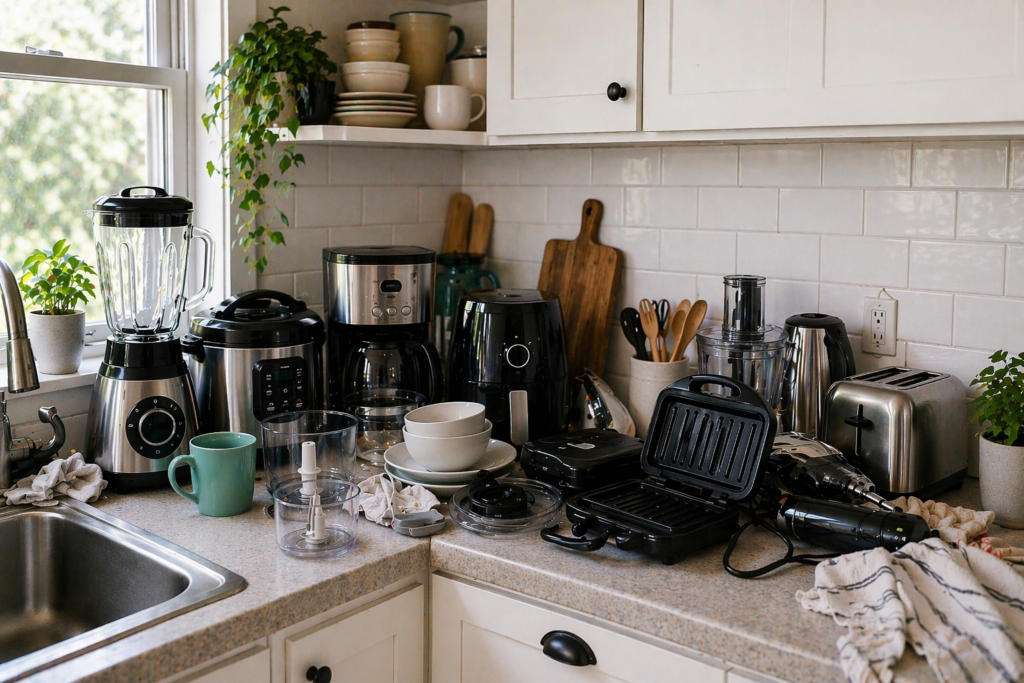
Your Kitchen Probably Isn’t Cluttered Because You Have Too Much. It’s Cluttered Because Nothing Works Together.
Most people assume clutter comes from having too many things. In kitchens, that’s rarely the real issue.
The problem is friction.
Appliances don’t fit your routine. They don’t fit your space. And over time, they start competing for attention, storage, and counter space.
That’s what creates the feeling of clutter, even when nothing seems obviously unnecessary.
Clutter Usually Starts With Good Intentions
No one buys appliances randomly.
You bought them to:
• Save time
• Make cooking easier
• Improve your routine
The issue is what happens afterward.
Some appliances don’t get used as often as expected. Others overlap with tools you already own. A few end up being too inconvenient to clean or store.
Instead of improving your kitchen, they slowly build friction.
This is the same pattern behind what’s explained in kitchen appliances that are actually worth buying vs what to skip.
The Overlap Problem Most People Don’t Notice
One of the biggest causes of clutter is functional overlap.
You might have:
• A blender and a smoothie maker
• Multiple coffee brewing options
• Several tools that do similar prep work
Each one makes sense individually. Together, they create redundancy.
That redundancy turns into clutter because every appliance needs space, even if it’s rarely used.
This is where kitchens start to feel crowded without looking messy.
Why Counter Space Becomes The Problem First
Clutter always shows up on the counter first.
Not because it’s the only storage space, but because it’s the most convenient.
Appliances that are used occasionally end up staying out “just in case.” Over time, temporary placement becomes permanent.
This is especially common with appliances that feel essential but aren’t used daily.
If you’ve ever wondered why your kitchen feels smaller than it should, it often ties back to choices explained in small kitchen appliances that actually save space and what to avoid.
Quick Breakdown: What Creates Clutter vs What Reduces It
| Creates Clutter | Reduces Clutter |
|---|---|
| Overlapping appliances | Multi-use tools |
| Rarely used devices on counters | Frequency-based placement |
| Oversized appliances | Right-sized appliances |
| Complicated tools | Simple, routine-based tools |
This is where small adjustments create noticeable changes.
The Hidden Role Of Convenience In Clutter
Convenience decisions often create clutter without you noticing.
You leave something out because it’s easier than storing it.
You keep multiple tools because switching feels like effort.
You buy something that simplifies one task but complicates everything around it.
Individually, these decisions make sense. Together, they reduce how functional your kitchen feels.
Why Some Appliances Never Earn Their Place
Some appliances never become part of your routine.
This usually happens when:
• They’re harder to use than expected
• They don’t match how often you cook
• They solve a problem you don’t consistently have
These appliances aren’t necessarily bad. They’re just not aligned with your habits.
This is a common issue with blending tools, especially when people don’t choose carefully from the start. That’s why guides like blender buying guide features sizes and tips for every shopper help avoid that situation.
Why Organizing Alone Doesn’t Fix The Problem
Most people try to solve clutter by organizing better.
But organization doesn’t fix a system that isn’t working.
If appliances overlap, don’t get used, or don’t fit your space, organizing just rearranges the problem.
That’s why clutter often comes back, even after a full reset.
How Storage Decisions Quietly Make Things Worse
Storage is often treated as the solution, but it can actually reinforce the problem.
When cabinets are already full, new appliances get pushed onto the counter. When storage is inconvenient, frequently used tools stay out permanently. Over time, this creates a split system where some items are hidden and others slowly pile up in plain sight.
The result isn’t just clutter, it’s inconsistency.
A better approach is aligning storage with frequency. Daily-use appliances stay accessible. Everything else should be stored in a way that doesn’t create resistance. If putting something away feels like effort, it will eventually live on your counter.
What Actually Fixes Appliance-Driven Clutter
The solution isn’t removing everything. It’s filtering properly.
A functional kitchen usually follows a few simple rules:
• Every appliance has a clear purpose
• Daily-use items stay accessible
• Rare-use items are stored away
• Overlapping tools are reduced
When this is applied consistently, clutter naturally decreases.
Why Size Mismatch Creates More Problems Than You Expect
One of the most common issues is choosing appliances that don’t match your space.
Oversized appliances dominate counters and reduce usable workspace. Undersized ones lead to inefficient cooking, forcing you to use multiple tools instead.
Both create friction.
This is especially noticeable with appliances like air fryers, where size plays a major role in usability. Choosing the right size from the start, using something like how to choose the right air fryer size, prevents this issue entirely.
How Small Daily Habits Turn Into Long-Term Clutter
Clutter isn’t just caused by what you buy. It’s reinforced by what you do daily.
Leaving an appliance out after using it once turns into leaving it out permanently. Skipping cleanup because you’ll “use it again later” becomes a routine. Keeping backup tools “just in case” slowly fills every available space.
These habits feel harmless in the moment, but over time they create a system where clutter becomes the default.
If this pattern isn’t corrected, even a well-planned kitchen will eventually feel crowded again.
Recognizing this is important because it shifts the focus from organizing to behavior, which is where lasting change actually happens.
How Decision Fatigue Makes Kitchens Feel Worse
Clutter doesn’t just affect space. It affects how you think.
More appliances mean more choices.
More choices slow you down.
You spend more time deciding what to use instead of actually cooking. Over time, this creates frustration and makes your kitchen feel harder to use.
A simpler setup removes that friction and makes everything feel more natural.
The Goal Isn’t A Minimal Kitchen, It’s A Functional One
You don’t need fewer appliances. You need better alignment.
When everything works together, your kitchen feels lighter, easier to use, and less stressful.
That’s what separates a kitchen that looks clean from one that actually works.