
This article contains affiliate links. As an Amazon Associate, I earn from qualifying purchases at no extra cost to you.
Most Kitchens Don’t Need More Tools. They Need Smarter Ones That Do More With Less.
A cluttered kitchen isn’t always about having too much. It’s often about having too many tools that only do one thing.
Single-purpose tools add up quickly. A garlic press, slicer, chopper, peeler, and cutter might each seem useful, but together they take up space and rarely get used consistently.
Multi functional kitchen tools solve that problem by replacing multiple items with one well-designed tool.
When chosen properly, they simplify your setup, reduce clutter, and make everyday cooking faster.
What Makes A Kitchen Tool Truly Multi Functional
Not every tool labeled “multi functional” actually delivers.
A good one should:
• Replace at least two or three separate tools
• Be simple enough to use regularly
• Be easy to clean and store
• Fit naturally into your cooking routine
If it doesn’t meet those criteria, it usually becomes another unused item.
This is the same pattern that causes clutter across kitchens, especially when tools are chosen without a clear purpose, as explained in why your kitchen still feels messy and what actually fixes it.
Best Multi Functional Kitchen Tools That Are Worth It
Some tools consistently stand out because they simplify multiple tasks without adding complexity.
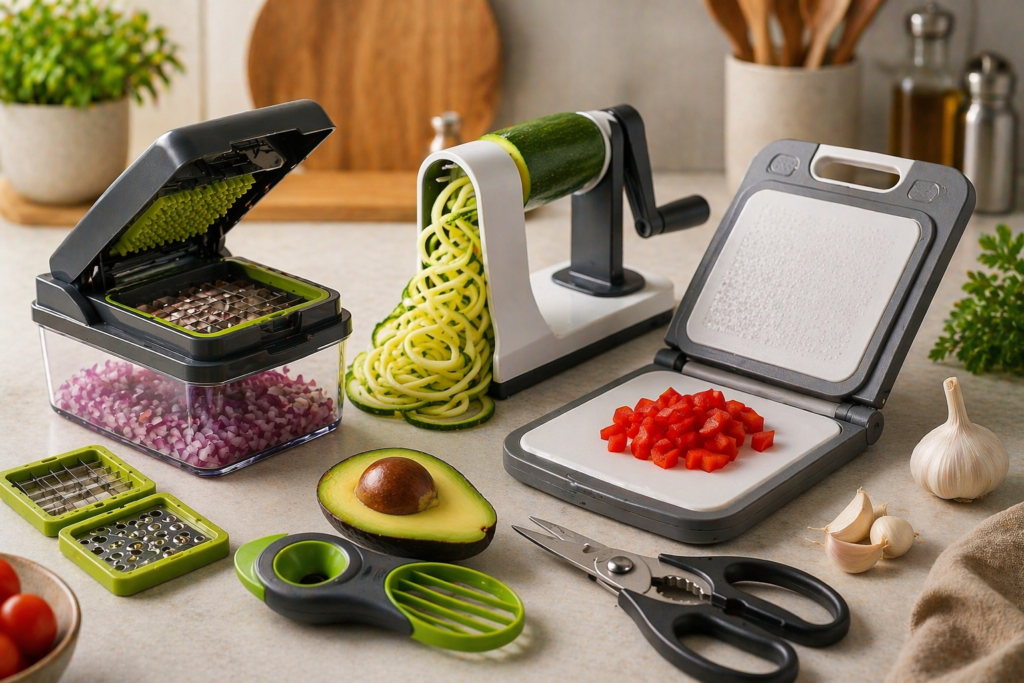
• OXO Good Grips 3-in-1 avocado slicer handles slicing, pitting, and scooping in one tool
• Fullstar vegetable chopper and slicer set replaces knives, graters, and cutters
• KitchenAid 5-blade spiralizer attachment works for slicing, peeling, and spiralizing
• Joseph Joseph chop2pot folding cutting board acts as both prep surface and transfer tool
These tools don’t just save space. They reduce the number of steps in your workflow.
Quick Comparison: Multi Functional vs Single Purpose Tools
| Tool Type | Multi Functional Option | Single Purpose Alternative |
|---|---|---|
| Food Prep | Vegetable chopper set | Separate knife + slicer + grater |
| Cutting | Folding cutting board | Standard cutting board |
| Fruit Prep | Avocado slicer | Knife + spoon |
| Peeling/Slicing | Spiralizer tool | Peeler + slicer |
This is where small changes create a noticeable difference in how your kitchen feels.
Why Most Kitchen Tools End Up Unused
The problem usually isn’t quality. It’s usability.
Tools get ignored when:
• They’re harder to use than expected
• Cleaning takes too much effort
• They only solve a very specific problem
• They don’t fit into your daily cooking habits
Over time, these tools stay in drawers or on counters without adding value.
This is the same issue seen across appliances as well, especially when people don’t filter properly before buying, as covered in kitchen appliances that are actually worth buying vs what to skip.
Why Multi Functional Tools Help Reduce Clutter
Every tool you remove reduces friction.
Instead of switching between tools, you simplify your process. Instead of storing multiple items, you only need one.
This creates:
• More counter space
• Less drawer clutter
• Faster meal prep
• Easier cleanup
It’s not about minimalism. It’s about efficiency.
How Material And Build Quality Affect Usability
One thing most people overlook is how much build quality impacts whether a tool actually gets used.
Cheap plastic tools tend to feel unstable, dull faster, and often break under pressure. When that happens, you naturally stop reaching for them.
On the other hand, well-built tools feel solid, cut cleaner, and perform consistently. That reliability is what turns a tool into something you use daily instead of occasionally.
This is especially important when choosing tools like cutting boards or prep tools, where durability directly affects performance, as highlighted in best cutting boards for kitchens protect your knives and prep smarter.
When Multi Functional Tools Don’t Work
There’s a tradeoff.
Some multi tools try to do too much and end up doing everything poorly.
This usually happens when:
• The tool is overly complicated
• Functions feel forced instead of natural
• Build quality is weak
• It replaces tools you already use well
In those cases, a simple, single-purpose tool might actually be better.
How To Choose The Right Multi Functional Tools
Before buying anything, run a quick filter:
• Does this replace something I already use?
• Will I use at least two of its functions regularly?
• Is it easier than my current setup?
• Does it save space without adding complexity?
If the answer is unclear, it’s usually not worth adding.
This same thinking applies across your entire kitchen setup, especially when reducing overlap between tools and appliances like in small kitchen appliances that actually save space and what to avoid.
Why Storage Compatibility Matters More Than You Think
Even the best tool can become clutter if it doesn’t fit your storage setup.
Bulky tools that don’t fit drawers or cabinets tend to stay on counters. Over time, this creates the same clutter problem you were trying to solve.
Good multi functional tools should not only replace other tools but also fit neatly into your existing storage.
If it doesn’t store easily, it won’t stay organized.
The Hidden Benefit: Faster Cooking Flow
Multi functional tools don’t just save space. They improve how you move through your kitchen.
Instead of stopping to grab different tools, you stay in one flow.
That reduces:
• Time spent switching tools
• Mess during prep
• Interruptions while cooking
This is what makes your kitchen feel easier to use, not just more organized.
How Tool Overlap Creates Long-Term Clutter
Clutter rarely happens from one bad purchase. It builds over time.
You buy a slicer, then a chopper, then a grater. Each one solves a small problem, but together they create overlap.
Multi functional tools prevent this buildup by covering multiple roles from the start.
This is also why kitchens that focus on fewer, better tools tend to feel more organized, similar to what’s explained in best knife sets under $200 quality kitchen knives that last.
What To Avoid When Buying Multi Functional Tools
Not every product labeled “multi functional” is actually useful.
Avoid:
• Tools with too many unused features
• Poor-quality plastic builds
• Complicated designs that slow you down
• Tools that are difficult to clean
These tend to create more problems than they solve.
The Goal Isn’t Fewer Tools, It’s Smarter Ones
A well-functioning kitchen doesn’t depend on having less. It depends on having tools that work efficiently together.
When each tool earns its place, everything becomes easier. Cooking feels smoother, cleanup takes less effort, and your space feels more open.
That’s what separates a cluttered kitchen from a practical one.
Top Picks from this Article
Want the short version? These are the most useful kitchen tools based on convenience, versatility, and everyday use.
A simple and efficient tool that slices, pits, and scoops avocados quickly, making meal prep faster and safer.
View price on AmazonA powerful attachment that transforms vegetables into spirals and slices, ideal for healthier meals and creative cooking.
View price on Amazon