
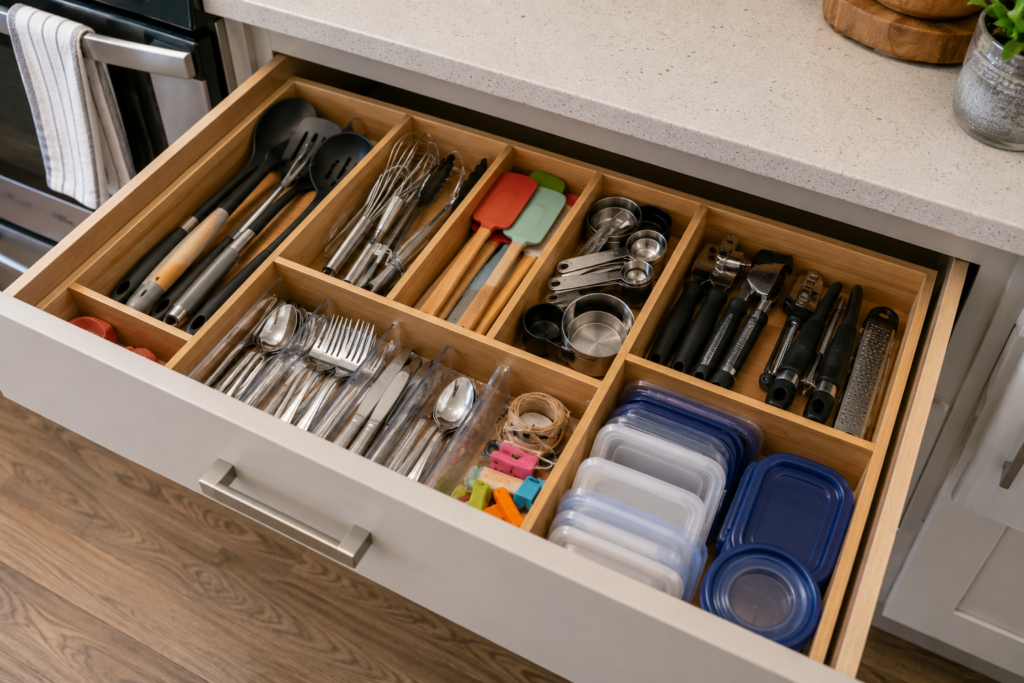
Kitchen drawers are some of the hardest-working storage spaces in any home. They hold utensils, cooking tools, food storage supplies, gadgets, towels, wraps, and dozens of small items that support daily routines. When organized well, they make cooking feel easier and more efficient. When disorganized, they create constant frustration that most people experience every single day.
Many homeowners focus on organizing cabinets, pantries, and countertops while ignoring drawers. Unfortunately, drawer clutter tends to grow quietly over time. A few misplaced items become a crowded drawer. A crowded drawer becomes a frustrating search every time someone needs a measuring spoon, vegetable peeler, or can opener.
The good news is that kitchen drawer organization does not require expensive products or a complete kitchen makeover. Small improvements often create noticeable benefits immediately.
Why Kitchen Drawers Become Disorganized So Quickly
Kitchen drawers are used constantly.
Unlike seasonal storage areas, kitchen drawers may be opened dozens of times every day. Utensils move around, new gadgets get added, and miscellaneous items slowly accumulate.
Many drawers become disorganized because they lack a clear purpose. When people are unsure where something belongs, drawers often become default storage locations.
Over time, this creates crowded spaces filled with unrelated items that make everyday tasks more difficult.
The Problem With “Temporary” Storage
Many drawer problems begin with temporary decisions.
A kitchen tool gets placed in the nearest drawer because there is no obvious home for it. A few days later, another item joins it. Eventually the drawer contains a collection of objects that were never intended to live together.
Temporary storage often becomes permanent storage.
Creating clear categories prevents this gradual buildup and helps maintain organization over the long term.
Why Small Frustrations Matter
Searching for a spatula may only take a few extra seconds.
Looking for measuring spoons might take another few seconds. Hunting for scissors, bag clips, or food thermometers adds even more time.
Individually these delays seem minor.
Repeated every day, however, they create unnecessary friction that makes cooking feel harder than it needs to be.
Organized drawers reduce these frustrations by making frequently used tools easy to locate.
Kitchen Efficiency Starts With Accessibility
Good organization is not about creating a picture-perfect kitchen.
It is about making items easy to find, easy to access, and easy to return.
When people can quickly reach the tools they need, meal preparation feels smoother and more enjoyable.
This is one reason many homeowners notice benefits similar to those discussed in why organized kitchens feel easier to cook in.
Assign A Purpose To Every Drawer
One of the most effective organizational strategies is giving every drawer a specific role.
For example:
- Cooking utensils
- Food preparation tools
- Baking supplies
- Food storage accessories
- Kitchen linens
- Everyday cutlery
When each drawer serves a clear purpose, it becomes much easier to maintain.
Items naturally return to their designated locations because the system is obvious.
Quick Comparison Table
| Drawer Approach | Result |
|---|---|
| Categorized Drawers | Faster Access |
| Mixed Storage | Frequent Searching |
| Organized Zones | Less Frustration |
| Drawer Dividers | Better Visibility |
| Dedicated Categories | Easier Maintenance |
| Overcrowded Drawers | More Clutter |
Utensil Drawers Benefit From Simplicity
Utensil drawers often become overcrowded because people accumulate more tools than they actually use.
Duplicate spatulas, extra serving spoons, and specialty gadgets can quickly consume valuable space.
The most effective utensil drawers focus on frequently used items.
Removing duplicates and rarely used tools immediately improves accessibility.
The goal is not minimizing ownership. The goal is making everyday items easier to reach.
Drawer Dividers Make A Bigger Difference Than Most People Expect
Drawer dividers remain one of the simplest kitchen organization upgrades available.
Without dividers, items shift constantly and categories gradually disappear.
Dividers create visual boundaries that help maintain order even during busy weeks.
This is exactly why drawer dividers that keep everyday clutter under control have become a popular solution for households trying to reduce frustration.
The Junk Drawer Problem
Almost every home has one.
Junk drawers often begin with good intentions. They provide a place for miscellaneous items that do not belong elsewhere.
Unfortunately, they can quickly become storage black holes.
Batteries, rubber bands, takeout menus, pens, receipts, tape, and random household objects pile up until finding anything becomes nearly impossible.
Even junk drawers benefit from categories.
Why Overcrowding Creates Hidden Clutter
Many homeowners focus on whether items fit rather than whether items function well together.
A drawer may technically hold dozens of objects, but if finding a specific tool requires moving half the contents, the drawer is not functioning efficiently.
Leaving some empty space often improves usability.
Organization is usually more about visibility than maximum storage capacity.
Food Storage Containers Create Unique Challenges
Food storage systems frequently generate drawer clutter.
Lids separate from containers. Odd sizes accumulate. Matching pieces becomes frustrating.
Creating dedicated zones for container accessories helps reduce confusion.
Many households find that simplifying their container collection creates immediate improvements.
Keep Daily Tools Close To Work Areas
Kitchen layouts matter.
Items should be stored near where they are used whenever possible.
Cooking utensils belong near the stove. Food preparation tools belong near preparation surfaces. Baking supplies should remain close to baking areas.
Reducing unnecessary movement improves efficiency and supports smoother cooking routines.
The Relationship Between Drawers And Pantry Organization
Kitchen organization works best when storage areas support one another.
A well-organized pantry reduces pressure on kitchen drawers because ingredients and supplies already have dedicated homes.
Many principles discussed in pantry organizers that make food easier to find apply equally well to drawer organization.
Categories, visibility, and accessibility matter everywhere.
Labels Can Support Long-Term Organization
Labels are not always necessary, but they can help maintain consistency.
This is especially true in family households where multiple people use the same kitchen.
Labels reduce uncertainty and encourage items to return to their correct locations.
That is one reason label makers that help homes stay organized long term remain useful organizational tools.
Why Visual Clutter Affects Cooking
Clutter is not only a storage issue.
It also affects how spaces feel.
Opening a crowded drawer filled with tangled tools creates a different experience than opening a well-organized drawer where everything is visible.
The organized drawer reduces mental effort.
Small reductions in mental effort often make daily tasks feel noticeably easier.
Kitchen Towels Deserve Dedicated Storage
Kitchen towels often become scattered throughout the kitchen.
Some end up in cabinets, others on counters, and still others mixed with unrelated items.
Creating a dedicated towel drawer simplifies storage and improves accessibility.
Simple categories often outperform complicated organizational systems.
The Importance Of Regular Drawer Resets
Even well-organized drawers gradually drift toward disorder.
A quick monthly review can prevent small problems from becoming larger ones.
Removing unnecessary items, restoring categories, and returning tools to their proper locations takes very little time.
Consistency is usually more important than perfection.
Why Families Need Simpler Systems
Complicated organizational systems often fail in busy households.
Family members tend to use the easiest available option.
If a storage system feels difficult or inconvenient, people stop following it.
Simple systems with obvious categories usually survive much longer because they require less effort.
Convenience supports consistency.
How Organized Drawers Save Time During Meal Preparation
Cooking often involves multitasking.
Ingredients need preparation. Tools need retrieval. Multiple steps happen simultaneously.
Organized drawers reduce interruptions because tools remain easy to locate.
This creates smoother workflows and reduces unnecessary stress during meal preparation.
Small improvements repeated daily can create surprisingly large benefits over time.
The Connection Between Refrigerator And Drawer Organization
An organized kitchen functions as a complete system.
Drawers, pantries, cabinets, and refrigerators all influence one another.
For example, households that follow strategies from refrigerator storage ideas that make groceries easier to find often find it easier to maintain organization throughout the rest of the kitchen as well.
Good systems tend to reinforce other good systems.
Organization Should Support Real Life
The best kitchen organization systems are realistic.
They account for busy schedules, family members, unexpected purchases, and changing routines.
The goal is not maintaining perfection.
The goal is making everyday tasks easier.
When drawers support daily life rather than complicate it, kitchens feel more functional and less stressful.
Why Organized Drawers Make A Bigger Difference Than People Expect
Kitchen drawers may seem like small storage spaces, but they influence countless daily interactions.
Every meal preparation session involves opening drawers, retrieving tools, and returning items.
When those processes become smoother, cooking becomes easier.
When drawers stay organized, people spend less time searching, experience less frustration, and enjoy their kitchens more.
Sometimes the most effective kitchen improvements are not expensive appliances or major renovations. They are simply better systems for managing the spaces people use every single day.